Showing posts with label religion. Show all posts

30 September 2009

Best. Art. Ever.

Ok folks. Art has reached its apotheosis. All you painters, sculptors, musicians and poets, nice try. Thanks for playing. Go do something useful, because ya done got served!

First there was Arnold "We Are Here to Pump You Up (In Your Spirit Muscles)!" Friberg.

Then the gentler, more photorealistic Del "Ja, den där er Jesus!" Parson.

And we can't forget Thomas "Paint the Light!" Kincade.

But now a new luminary graces us with his art. An art to end all art. Jon "It's a McNaughton!" McNaughton.

BEHOLD!
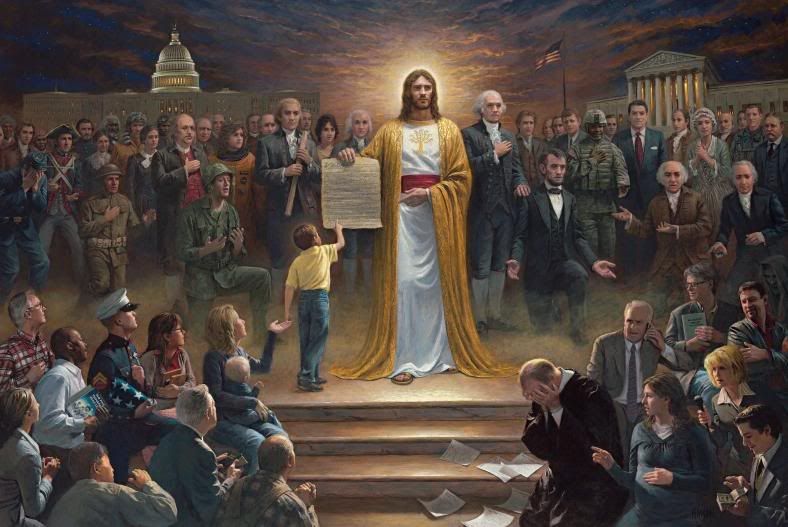


I know, you're stunned. But there's more. Just in case you're like me, and The Full Meaning of this marvelous, "symbol*"-laden Depiction of Pure Truth (ya heard?) overcomes your aesthetic and congnitive capacities, the Artist has provided (via the magic of the interwebs) an explanatory apparatus here. Trail your mouse pointer over the various Symbols to see their explanations rendered in Truth No Less Powerful for Its Clarity.

And if those explanations aren't enough, you can always join me in taking one of Brother McNaughton's workshops. Know this, though:
One last word—I will endeavor to teach you everything I know except for one thing—"The Grand Master Secret." This is the most important principle I can teach, but I am cautious to whom I reveal it. I have had only a handful of students who have solved the code in the back of the wordbook. I truly believe it is the key to knowledge.
I'm totally going to figure out that code. (I wonder if Brother McNaughton's Grand Master Secret is anything like this guy's.)

Post your favorite parts in the comments section, that we all may be edified. (Note: be sure to check out the titles of books and the court cases littering the steps. And don't forget to look in the sky.)

UPDATE: A friend sent me this alternative interpretation. Once again, let your mouse do the walking.

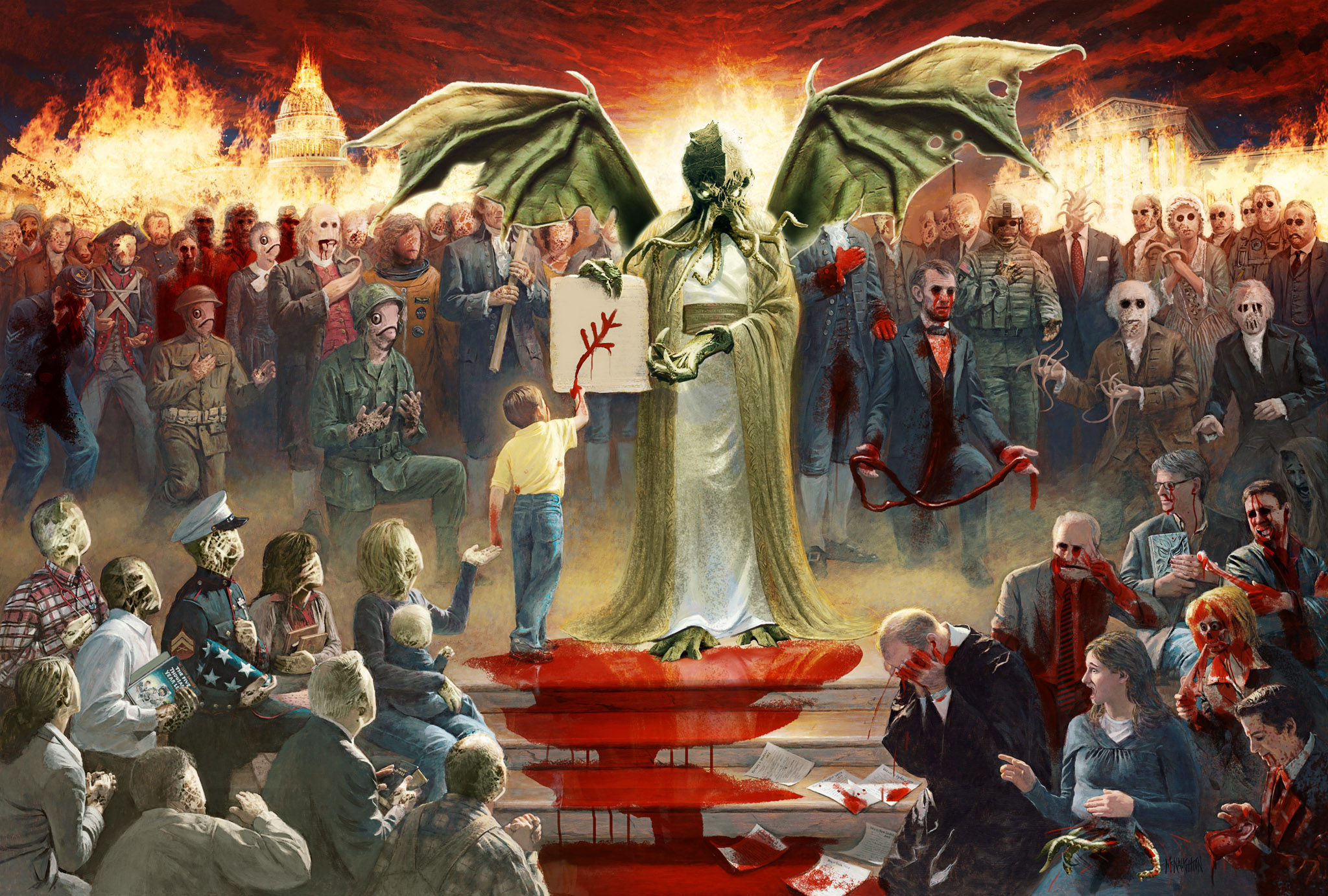
UPDATE 2: Another friend sent me this parody, which is only slightly less frightening than the original. Witness: "One Nation under Chthulu."

___________
*Warning: Symbols not actually symbols, but literal depictions. From the OED: symbol (n.), 2. a. Something that stands for, represents, or denotes something else (not by exact resemblance, but by vague suggestion, or by some accidental or conventional relation); esp. a material object representing or taken to represent something immaterial or abstract, as a being, idea, quality, or condition; a representative or typical figure, sign, or token. (Emphasis mine.)

Credits: Hat tip to Old Sport for bringing this wonder to my attention in the first place, and to Swearing Elder for directing me to the workshops.

12 January 2009

Narrative, Hope & Everything — Part Deux: (b) The Scriptures II

[Previous posts in the NH&E series: Part 1, Part 2, and Part 3.]

In a previous post of this series, I argue that the scriptures are a collection of texts from a number of genres. I focus on myth and history, and invite a reconsideration of the connotations attached to those two words in social and religious contexts.

I began the post, though, with a question: What do we do with the scriptures? In this post, I’d like to ask what the ancients (our ancestors) did with them and how that may inform what we might do.

Though our definition of history is by no means new (see my last post, or ask Dirk —who knows far more about it than I do)— the way we privilege it over myth (or fiction) is. I got into this in the last post in general terms, but I think it’s important to understand that those who read (or, mostly, listened to) the scriptures in earlier times valued them as good, as normative, as the word of God, no matter their genre.

Put another way: it is highly unlikely that listeners even as far back as the ninth century BCE believed that the story of Adam and Eve as we know it today (or rather, the stories of Adam and Eve; we LDS have four distinct creation texts) happened as it was eventually written down. The ancients were much more sophisticated than we tend to give them credit for; they understood both explicitly and implicitly the power of the word and of the word organized*.

Ancient consumers of the scriptures (readers/listeners) didn’t demand that the scriptures be strictly, literally, historically accurate for them to be true the way we do today. They could learn all sorts of things from Adam and Eve without needing Adam to have ever lived. They expected elaboration, amplification, exaggeration, over- and understatement, metaphor and all manner of “literary” devices—in short, they accepted and expected that the producer (writer/speaker) would have a hand in the making and telling of the story. (In fact, they would probably view/hear a text that didn’t show some expertise in narrative technique —even one that claimed historical literalism— to be both uninspiring and uninspired.)

Moreover, they were more attuned than we are to differences in literary genre and what those differences signaled in terms of genre expectations. To wit: we can watch thirty seconds of any TV show and identify it as drama, news, fake news, soap, “reality,” sitcom, gameshow, or any number of other genres and subgenres by the visual and linguistic cues we identify with each. Similarly, oral and early literate cultures could listen to (or read) a few lines and distinguish a myth from a poem, a chronicle/history from a liturgy, a psalm from a statute. They did not expect each of the many and various texts that today comprise our holy writ to be uniform in purpose or source.

There is a great deal of evidence that both the Hebrew Bible and the Christian New Testament were redacted and revised (literally re-vised, re-seen) several times before being fixed in the forms they currently take. The Hebrew Bible (roughly analogous to the Christian Old Testament) shows evidence of four major rewrites over roughly five centuries. These revisions (read: re-seeings) took older texts and adapted them in tone and detail to the needs of the day, adding or subtracting elements as they required to make the text more relevant to their particular situations.

Of course this doesn’t rule out divine guidance, inspiration, or revelation. Just take a look at the changes made to LDS publications since 1830 (including the Book of Mormon, the Pearl of Great Price, or the various periodicals) for evidence that God can tailor his message to the specific contexts of his children. Compare the Old Testament to the Doctrine and Covenants. What percentage of the former do you find relevant to your everyday lived experience? Less than the latter? Take just the dietary codes, or the guidance regarding marriage, or almost any topic you can think of. I’d guess that the D&C is more familiar, less strange, in many ways, than the much older Biblical text.

So, in a thousand years (assuming either is still read), will be the relationship of the D&C to whatever more contemporary scripture the Saints are reading. Many of Joseph’s revelations will doubtless seem strange and unfamiliar to people living a millennium from now — or they would be only dimly recognizable to us, having been revised and rewritten so as to speak more directly to our descendants’ needs (and, no doubt, desires).

The take home message: the scriptures are not monolithic or homogeneous, much as we moderns try to make them so. To assume that each contributor to holy writ somehow experienced the divine in exactly the same way as his forebears and successors is to set ourselves a series of irreconcilable polylemmas — that is, to make all the prophets from all times say exactly the same thing in exactly the same way. To wear our minds out in exhausting and pointless pseudologically gymnastic exercises explaining away difference and contradiction (etymologically: “speaking against”).

One of Joseph Smith’s theological innovations was his insistent democratization of access to the divine. Let us look to the scriptures through that lens, believing in a truly personal God who can speak to each of us, in our time, in ways that may not make sense —and, more importantly, need not make sense— to anyone else. Let us celebrate the incredible multiplicity of our human family’s experiences of the divine and the attempts to scribe those experiences that they might be shared and so testify to the wonder that is God and his love for each child.

_______________
*In many ancient Near Eastern mythologies, the world itself was created and order established precisely by means of language, which is itself a system of organization and a way of making meaning out of chaotic experience. See Marduk v Tiamat, or Ba'al (and later Yahweh) v floods.

12 November 2008

I Will Strangle You...

I'm suspending (briefly) my strict No-Christmas-Before-Thanksgiving's-Over policy to issue this public safety announcement.

If I am within earshot when you complain that writing X-mas* is "taking the Christ out of Christmas," I will strangle you.

If you care to know why writing Xmas is not taking the Christ out of Christmas, read on.

Christ is the Anglicization of the Greek word meaning "the anointed." Since it's Greek in origin, people tended to write the title using the Greek alphabet. (I know, go figure.)

The Greek letter that begins the transcription of christos is called "chi" and written thus: X.

Xmas, then, is a sort of bastardized abbreviation comprised of both Greek and Latinate roots (-mas from missa, meaning "dismissed," from the last phrase of the Catholic liturgy of the Eucharist, and therefore by synecdoche, Mass itself.)

So I don't want to hear it. I'm serious about the strangling.**

*Or any variation thereof.
**This last sentenced should be pronounced in a bad Christopher Walken imitation: I'm SERious ... aBOUT... theSTRAngling.

09 November 2008

Pierglass Candleflame

Since I posted my reaction to Prop 8's passing in California, I've been the recipient of a number of caring phone calls, letters, lunches, and (vicariously) midnight resistance meetings. Thank you, all (you know who you are). I'm leaving comments disabled on this post, too, for the same reasons as on the last one: they're what I have to say. If you feel similarly or differently, you have your own blogs!

Though I still get angry, sad, and frustrated about this issue, I've learned a couple of things:

1) I'm by no means alone, even among LDS (Mormon) communities, in feeling the way I do. My anger, sadness, frustration and sense of urgency on this matter is shared by far many more than I would have guessed a few weeks ago.

2) This issue matters, and it isn't going away, and if history is at all relevant, eventually the people, then the government (and finally even the Church) will come around. My daughter evinces this already. As wiser minds have pointed out: there's almost nothing that the LDS church isn't willing to change its position on, given enough time and enough grassroots social pressure.

3) My wife and I have decided (her idea, actually) that in order to remain members of the church and maintain some semblance of integrity we will need to be open and honest about our feelings on this issue; therefore we're meeting with our bishop to let him know how we feel. (This in keeping with MLK, Jr's 4-fold Guide to Nonviolent Protest, step 4: direct action. I'm still working on step 3.)

Thank you; that is all.

05 November 2008

Dark

I have a post coming about President-Elect Obama's victory speech last night at Grant Park. Like Annie writes: chills. (The good kind!)

And despite how elated and hopeful I am that the next four years will see this country's name more accurately describe our nation, I find myself in the grips of a profound, dark sadness.

52.5 percent of California voters cast their ballots in approval of Proposition 8, which amended the state's constitution to eliminate the right of same-sex couples to marry.

My depression stems only in part from the evidence that slightly more than half of voters in the Golden State feel their way of life and love threatened by others' love. That sadness is largely assuaged by two factors: 1) this division in our culture will most likely not outlast my daughter's generation; and 2) though marginalized in conceit, all California couples are legally entitled to civil privileges and protections. (#2 is tempered by the fact that I agree with the Connecticut Supreme Court that separate is not equal, and will continue to do whatever I can to support the eradication of discriminatory laws and practices.)

What really gets me is the position of my church on this issue. What's more, the fact that had my church not thrown its support so zealously behind this proposition, the ballot measure would almost certainly have failed.

As a like-minded friend of mine writes,
I continue to read the reactions of gay and lesbian Californians that feel hurt and betrayed and frustrated. They have partners that they love. Many of them have children that they love. [Just over half of] Californians yesterday decided that those families don't matter and that those marriages are second-class. I think many Californians that voted yes on Prop 8 truly don't realize the pain they're causing. I think many feel torn and conflicted, and voted yes out of deeply held religious beliefs. I can respect that even though I disagree.

I've read of families who have donated their life savings, their kids' college funds, way more than they can afford, to support this amendment. Though I don't know if this list of donors is complete, I don't find any of the First Presidency or Quorum of Twelve on it (unless the entry for one "THOMAS S. M" from Concord, CA, is who I suspect it's not).

The LDS Church has a wonderful opportunity to be ahead (or at least abreast) of history here. It has a wonderful opportunity to champion love, tolerance, families, and community. It has a wonderful opportunity to speak to a new generation, many of whom will reject out of hand the idea that a person's sexual orientation defines their worth as a human being, as a husband or wife, as a parent, as a citizen, or as a servant of God.

Try as I might, I cannot reconcile the Christ I witness with the Church's behavior in this matter. I am left wondering what I have to give to the Church, and what it has to offer me.

Perhaps I've let go the iron rod and wandered off into paths unknown. Perhaps the jeers from the great and spacious building have made me ashamed. Perhaps I have stoned the prophets and esteemed the word of the Lord for dross. Quite probably the despair I'm feeling is evidence that I'm on the wrong path, divorced from the Spirit of truth.

I don't know. I just hurt, and I'm angry. For me. For my church. For my family, in the largest, most encompassing sense of the word.

01 October 2008

Narrative, Hope & Everything — Part Deux: (a) The Scriptures I

So what do we do with the scriptures?

First, we should decide what they are. As texts, they comprise any number of genres, but the two most common are history and myth. (Also included are legal documents, poems, epics, epistles/letters, etc.)

A history is a text that seeks to describe lived events as they occurred. Since Herodotus and Thucydides in the fifth century BCE began the practice of not only writing down stories about past events but also attempting to compare and verify those stories to select the most accurate, history has sought to present as objective a record of human action as possible. You've heard the truism, though, that winners write the history books, and that's true. There is always some human bias in the selection and description involved in historiography. The values and ideologies of a historian's culture inevitably color her project.

Myth, like history (which it predates), attempts to explain events and phenomena by means of a causal narrative. (Tempests are the result of Poseidon’s anger; earthquakes and volcano eruptions are caused by Hephæstus laboring in his subterranean forge; this rock is glowing because it was touched by the finger of God.) Myth makes no pretense to objectivity; a culture’s myths explain its identity, its origins, its divine right, its social and legal values. Édouard Glissant writes that communities’ "identity [is] achieved when communities attempt to legitimate their right to possession of a territory through myth or the revealed word "(13). That is, our sense of who we are individually and within our various collectives (cultures, nations, churches, etc.) is founded in a group of narratives that tell us about our relationship to each other and to our god.

Today we tend to value history over myth. History is modern and legitimate; myth is antiquated and benighted. History is scientific and verifiable; myth is fairy tales and cute stories. Everyone knows that earthquakes are the result of tectonic shear, and that there is no (nor has there ever been any) such being as Hephæstus. History happened; myth was imagined. History is true; myth is false. History is ancient Israel’s divinely inspired writings; myth is the product of those pagan Greeks/Indians/Africans/Mesoamericans/Others and their silly multiple/multiply-limbed/animal/nature/bloodthirsty gods. History is what We know; myth is what They believe.

But we discount myth and mythmaking not only to our loss but to our condemnation. Mythmaking is essential to and reflective of our own narrative identity-making on any number of levels. We hold in our memories a number of stories and ideas about every group to which we belong from our world to our nation to our state to our town to our family (to ourselves—our Self/ves).

These stories may be straight history. They may be history inflected with mythic elements and values. Or they may be mythic narratives outright. In each and every case, they can be true. They can tell us true things about ourselves, our true relationships with others and with the divine. Myth can be as true as history.

Of course, myth isn’t necessarily better than history. Both are highly contextualized, contingent to the goals, limits, and worldview of the mythmaker or historian, or their cultures/nations/ideologies. Myths and histories can help us obscure the truth of our inherent connection to others, and can be powerful tools in both committing and justifying violence against those made Other by our myths and histories.

So what’s the point, you ask. This: that the scriptures are no less potent if we read them as myth rather than as history. In fact, doing so may make us more able to acknowledge the points where they obscure, rather than illuminate, the truths God wants us to have.

In such a view, we don’t have to believe that the earth was created in six twenty-four hour periods, or to parse the conflicting details in the four different creation accounts we have in the LDS canon. We don’t have to worry about what Noah did with all that animal dung (or how he managed to get two of every animal on board a single craft in the first place). We don’t have to explain how a man lived inside a sea creature for several days, or why there doesn’t seem to be enough ancient Mediterranean DNA in modern Native American populations.

We can focus on what the scriptures tell us about being human, and living with other humans. The dangers of discriminating according to ethnic, racial, or gender differences. The power of the two great commandments to heal us and bind us together. The absolute horror and evil of war, and the inescapable toll of killing. The absolute good of love and forgiveness.

24 September 2008

Narrative, Hope & Everything — Part Deux

If something here doesn’t make sense, try here first. Then try this.

Since our worlds are made of (or at least lived through) narrative, it can be useful to understand as much as we can about those narratives. Who creates them? Why? To what ends? We will probably never be able to get simple or even entirely objective answers to these questions in most cases. Moreso with those narratives that are at the core of our deepest experiences. But I’m convinced that it is important to try.

The narrative I struggle most to comprehend and (redundantly, in English) to come to grips with — and to reconcile with the many other narratives that warp and woof their ways through my worlds’ text(s) — is that of my religion: late twentieth-century western-U.S. Mormonism.

(Lest you think I overclassify, consider what happens if we change just one of the qualifiers. Mid-twentieth-century western-U.S. Mormons lived a different narrative than the one I’m familiar with on many levels from the superficial (my dad recalls his childhood bishop meeting families for burgers and fries on Sunday afternoons after services) to the most profound (his experiences in the temple differed significantly from mine). Change more than one qualifier, and all sorts of “givens” fly out the window and are up for grabs: plural marriage and attitudes toward procreation; priesthood privilege with regards to both gender and race; the relative hierarchy of sins; etc.)

There are at least three different big narratives (we'll be fancy and call them metanarratives) that compete with each other for our attentions. A metanarrative is (according to the OED)
a piece of narrative, esp. a classic text or other archetypal story, which provides a schematic world view upon which an individual's experiences and perceptions may be ordered.
A longer discussion can be found here. My friend Dirk Handlebar (this magnificent bastard) classifies these contesting metanarratives thus:
  • the scriptures;
  • the various writings and revelations of Joseph Smith (and, to a lesser degree, other past prophets);
  • and modern day church leaders and prophets.
It is argued that these sources all teach the same things, or that their narratives work to the same purposes. I disagree. There are significant differences that clamor for attention, and part of being a member of the LDS church is the constant juggling of these narratives' claims to relative authority.

The next several posts will address certain of the defining characteristics of these metanarratives as I see them with an eye toward their traction (or lack thereof) on everyday religious experience (or lack thereof!).

22 September 2008

Narrative, Hope & Everything — Part I

Note: I should know more about what follows than I actually do. If you are a serious literature critic or philosopher of language, please feel free to correct my errors/expose my débutanterie.

Narrative is a fancy word for the process of storytelling. It’s the process by which we relate events to one another along a timeline to tell a story. We usually structure the narrative such that it starts at a beginning, moves through a middle, and comes to an end. Further, narratives tend to assign causal relationships to the events they narrate. Thus, the events in the middle of the narrative are “told” in such a way as to make it clear that they were caused by the beginning events, and will in turn be the cause of the end events.

It’s not only famous authors who engage in narrative. We all do it, all the time. Our selves, our lives, our relationships, and our worlds are a more-or-less constant process of narrative. It’s how we make sense of our experiences, how we make sense of and view the world. This is so because much of life has no meaning.

I’m not saying that life can’t have meaning. Only that it doesn’t until we provide it through our narration. Our lives are full of meaning. But that meaning is largely constructed by and for us through the process of narration. Our experiences (the physical sensations received through our sensory faculties (eyes, ears, nose, mouth, skin, gaydar, georgempathy, etc.)) are just physical stimuli: pressure waves, ricocheting photons, molecules that fit specific sites on certain cells. These stimuli don't — can't — mean anything in and of themselves.

Our brains interpret those signals and organize them into concepts, which then are put into (you guessed it!) narratives. Much of our growing up is a process of learning to read not only words printed on pages, but also the concepts that flood into our brains all day long. Both sorts of reading are learned according to essentially the same model: an example is demonstrated and explained, over and over, until we know that the series of squiggles that looks like this /father/ mean, when written or pronounced, the man who takes care of us.

Similarly, we learn to read experiences into narratives by hearing narratives. "Daddy can't play right now."

"Why"

"Because I have to work."

"Why?"

"Because ...."

And so on and so on, until a narrative of cause-and-effect is composed (Dad can't play because the exigencies of late consumer capitalism demand that he put in his eight to ten hours of daily banality so that he can buy you your Polly Pocket Wets Herself dollies... "Why?" "Exactly.").

A lot goes into our instruction in "experience grammar." Most of these factors we'd call culture. For me this includes the late twentieth century. The Pacific Northwest. Late 20th-century U.S. Mormonism. Etc. Language also plays a part, albeit much more subtle, usually. Certain concepts get framed in certain ways because of the words (or lack thereof) we have to describe and narrate them.

I've been really interested lately in how religion (specifically the late 20th-century Mormonism I referenced above) works to shape my world narrative and to give meaning through it to my experiences. The next few posts will explore this influence, and where I am today in terms of it. I hope you enjoy, and even more, I hope you comment.

17 September 2008

Narrative (teaser trailer)

From a novel I'm currently reading:
Thousands of years ago, the work that people did had been broken down into jobs that were the same every day, in organizations where people were interchangeable parts. All of the story had been bled out of their lives. That was how it had to be; that was how you got a productive economy. But it would be easy to see a will at work behind this: not exactly an evil will, but a selfish will. The people who'd made the system thus were jealous, not of money and not of power but of story.

04 September 2008

Does "Less Blessed" = "Less Fortunate"?

During his speech tonight at the RNC, Senator McCain said that his wife Cindy's "concern for those less blessed than we are ... show [sic] the measure of her humanity."

This reminds me of a phrase I often hear at church and in prayers: the wish that God bless those "less fortunate" than the speaker.

Are these two expressions equal? Are people less fortunate because they are less blessed? Are people less blessed because they're less fortunate?

This is an idea that goes way, way back in U.S. philosophy. In fact, it predates the U.S.A. In a famous sermon given on board the Arbella in 1630 by the British immigrant and Massachusetts Bay Company Governor John Winthrop, the Puritan leader argued essentially that God made some rich and others poor "for the glory of [their] Creator and the common good of the creature, man." It was important that both rich and poor existed, so that "so that the rich and mighty should not eat up the poor, nor the poor and despised rise up against and shake off their yoke."

That is, poor people exist so that rich people can learn to be charitable. Rich people exist to govern the poor people. This causal link between material prosperity and God's favor is, it seems to me, a shaky proposition theologically, but it fits well into the idea of the (U.S.) American Dream and the concept of (U.S.) American exceptionalism.

By Winthrop's logic, and, it seems, Senator McCain's estimation, those who are materially prosperous are so because they are more blessed by God. By the same logic, then, those who suffer more of the many indignities of human life are less blessed.

I reject this equation of wealth and prosperity to blessing. We may receive whatever we have because God loves us. But what we have is not and should never be seen as an indication of God's favor. Such is a perversion of our relationship with our Heavenly Parents, a mean quantification of inscrutable providence and invaluable charity.

10 July 2008

Revelation, obedience, conscience

Or, in other words: gay marriage.

I'm not trying to poke the bear, as it were. I just want to get this out there, and y'all can discuss or not. However you come down on this issue, please know that I harbor no hard feelings, nor do I think you're cooler if you agree with me. (I'm the kind that doesn't really want to belong to any club that would have me...)

You may have heard (I don't know, maybe I'm the only one) that the family is under threat. You may also have heard (again, maybe it's just me) that the Number One Threat to the Family in this day and age is the civil redefinition of marriage to include all adult couples, rather than just the traditional heterosexual unions we're used to.

This redefinition, according to some, poses a grave challenge to "traditional marriage" — the civil and religious union of a man and a woman. The supposed consequences are no less than the degradation of the "traditional family" and eventually the downfall of society as we know it.

I've had a lot of discussions with a lot of friends who fall on both sides of this issue, and I feel like I've heard most of the arguments for both sides. (I'd love to hear if I've missed any compelling argument pro or con, though.)

Here's what I currently think: marriage between two caring, consenting, committed adults is a good almost without equal, no matter the gender or sex of the partners.

My position is based on the following assumptions:
  1. The family is the basic unit of our society. When it works, it's great. Really, really great. For a lot of very compelling reasons (intimacy, monogamy, stability both emotional and financial, and on an on). More families = stronger, more vibrant society.
  2. Monogamous sex in a caring, consentual, committed adult relationship is a really, really good thing — regardless of the gender or sex of either adult. That is, there is nothing that makes heterosexual sex more or less moral than homosexual sex, or vice versa.
  3. There is no accepted evidence that same-sex couples do any worse at raising children well than do mixed-sex couples. Until such evidence is produced, there seems no compelling reason to assume that a same-sex couple would be less capable parents than a mixed-sex couple.
  4. There is accepted evidence that traditional, heteronormative marriages are in more trouble today than they have been in the past. There are many reasons for this — none of which is the growing acceptance of same-sex marriage. Debt due to consumerism and infidelity top the list. Gay marriage isn't even on it.
  5. There is more evidence every day — even from the LDS Church leadership! — that sexual orientation is innate and not a deliberate (and rebellious or sinful) choice, as it has been presented in the past. In fact, LDS leaders have stated unequivocally that sexual attraction (hetero- or homosexual) is not inherently sinful.
Same-sex marriage doesn't affect my marriage in any way that I or my wife or our daughter can perceive. Had it been an option when I was single, it would not have affected my decision to marry my wife, nor has it been a consideration in our decisions about when and how many children to try for. I wonder for how many members of the church it has been.

I just fundamentally do not get why same-sex marriage is a bad thing — except that my church tells me so. And apparently (at least according to whomever is writing the Daily Universe editorials these days) "'active Mormons' know that when the prophet speaks, the debate is over."*

Which brings me to the title and real question of this post: what to do when the same mechanisms by which I trust in the soteriology of LDS Christianity lead me to a conviction that is at odds with official statements from Salt Lake?

As a missionary, I got a lot of mileage out of a rhetorical fallacy that hinged upon the promise of personal revelation from God in Moroni 10:3-5. I assured people that they could know the truth of all things (but especially the Book of Mormon's authenticity) if they would pray with real intent. Then, I argued, if God confirmed to them that the Book of Mormon was true, they would ("logically") have to accept that Joseph Smith was a true prophet, and therefore that everything else he said must be true, too.

Of course it doesn't work that way. I love the Prophet Joseph, and revere him as a holy man who spoke, when moved upon by the spirit, for God. I value the scripture we have because of him, and the religious heritage he bequeathed us. But he was wrong about a lot of things. And, to his credit, he often acknowledged his shortcomings and failures — another of his qualities I admire.

What do I do, then, when I apply Moroni's promise to the "problem" of same-sex marriage? When I ask in faith, with real intent, whether it's immoral and dangerous and wrong, and get a no as definite and unequivocal as the yes I get when I ask whether Joseph was a prophet and whether I should remain a member of the church he founded? I can tell no difference in the mechanism or the means of the process. And so I find myself compelled by the same faith I hold in Joseph's message to believe also that monogamous sexuality is good when attended by the bonds of marriage committment.


*Never mind that no prophet, seer or revelator (latter-day or ancient) has ever uttered this statement. Closest these days is Elder Oaks, with his dictum that one should never criticize the prophet, even if he is wrong.

18 June 2008

Why I'm Celebrating with (Some of) California

I'm sure you've heard that the California State Supreme Court struck down as unconstitutional the state ban on same-sex marriage, and that couples have been crowding into courthouses to pledge themselves to one another.

Kitti and I are about to celebrate our tenth anniversary. (I know that's peanuts for some of you; for others it may seem like a day far off in the mists of thirtysomethinghood.)

I'm grateful today that in at least two states in this union, every pair of consenting adults who so desire can honor their relationship — and have it officially honored in return by the state — just as Kitti and I have been blessed to for the past decade.

There is nothing greater, more wonderful or sustaining in my life than the marriage I share with my wife. Through it I have learned — more than I might ever have done alone — of friendship, comfort, love and the pure charity of Christ. The Atonement is real to me because of my relationship with Kitti: there is no one who knows me as intimately as she, no one who has greater standing to justly judge me, no one who has forgiven me more thoroughly my trespasses.

For me to support denying a brother or sister the exquisite joy of knowing salvation in this life, of tasting forgiveness and hope and unconditional love — simply because they feel attracted to someone I don't — for me, would be unconscionable. It would be to deny everything I know that is praiseworthy and of good report in the world; to cast stones pretending sinlessness.

As I celebrate my marriage, I celebrate, too, the union of all those couples who commit to comfort, mourn, love and marry.

ADDENDUM: I strongly recommend listening to this podcast; it treats this issue from a perspective I don't very often see.